Tuesday, June 8, 2010

The Rally of the Big "T"

Disclaimer: Everything in this post is factual, except for the parts that aren't..


Nowadays, students are becoming more aggressive. They seem to complain about almost everything. Sometimes, I even see students rioting in a rally, shouting, walking with vulgar banners, and sometimes even naked. It kept me bothered as to why some would do this (I actually thought of things like that myself). I thought students are supposed to be educated individuals? Shouldn't they at least act more decent? These questions kept rumbling in my mind as I drink my ever favorite *mocha frappe venti at my equally favorite "tambayan". After seconds of discerning (well, that was all it took for me to think), I suddenly realized why some students acted that way. Surprisingly, I feel for them. Maybe (a theory of my own), it was because of the severely disliked, highly over rated ordeals that every student must face. Those sleepless nights keep you groggy for the day and the pimple marks keep the girls away (OUCH!). It's those 8x11 (or sometimes 8x13) menace that crack our minds as if we needed exorcism. Do you know what it is? It's a 5 letter word which can be spelled as I-N-S-A-N-E.


What drives students crazy?


...


T E S T S


OK, so much for an introduction (haha!). Now to the serious part. No matter how morbid my conception about tests is, there are still some (very few if I might add, hehe..) that prove to be beneficial to everyone. Let me give you 2 ironies that could help in discussing this.


IRONY #1: TESTS could help your STRESS.


By this time, you should have read my previous post so as to catch up. Cortisols, being produced upon stimulation of the adrenocorticotropic hormone (ACTH) is increased in times when we get stressed. Abnormally high and low values of these are detrimental to an individual.


If your doctor suspects high levels of these in your body, he may ask you to take a TEST. Worry not, 'cause this isn't as stressful as taking your CLINICAL CHEMISTRY MAJOR EXAM. First, you are asked to take the cortisol enzyme test which is usually verified through Radioimmunoassay (clickable link #1, hehe..). The specimen is usually blood (serum or plasma) drawn at 8am and 4pm, (for marked cortisol increase) and a single 8am specimen (for marked decrease). If you're results are unsatisfactory, then the doctor would advise you to proceed with either of these 2 tests:


1. Dexamethasone Suppression (if marked increase)
In here, you are given an oral synthetic glucocorticoid (dexamethasone) which suppresses ACTH production. Usually, if the cortisol production would decrease after this, the problem lies on the pituitary gland. (clickable link #2)

2. ACTH stimulation (if marked drop)
You are injected with synthetic ACTH in this test. If your cortisol level will rise, then it means your passed (normal).


Every test has its passing grade (so much for those demanding quotas). For this test, the passing rates are:
8am-noon: 138-690 nmol/L
8pm-8am: 0-276 nmol/L


If you're interested in applying for this test, know the details here (clickable link #3).


IRONY #2: TESTS could tell if you're DRAINED.


Aldosterones are hormones which greatly affect hydration. For testing this hormone, there are certain instructions to be followed (like those mind twisting instructions before tests). You will be advised to lie down or sit in an upright position for 15-30 minutes prior to blood collection. Oh! And also you are not allowed to intake licorice for at least 2 weeks before the test (this may falsely decrease the hormone). Then, plasma (or serum) is prepared and subjected to RIA too.


Passing scores:
for lying: 55-250 pmo/L
for upright: 2-5x the value of the lying


For a the details of the test, check this out.


-BONUS-
A video of the aldosterone action:


Phew (again)! Too much testing really gives me headaches. Well, at least now we could think twice as to whether we should rally to the streets when we hear the word TEST. Hope you enjoyed! = }


-SIDETRACK-
The first one to perceive these figures the same as I do (facts of life) 
is in for a treat*. Same drink, Same place. = }

Tuesday, May 25, 2010

Adrenal Cortex and its Hormones


Mr. Bishop, a 43 year old ace blogger, has type 2 Diabetes Mellitus and frequent high blood pressure. He woke up one day noticing purplish pink - colored stretch marks on his abdomen, thighs and buttock. Also, he was easily bruised but hard to heal. Alarmed, he visited his physician immediately. The physician later noticed Mr. Bishop's high cortisol levels. He was then subjected to further testing.


...


OK, so we started off on a serious note. Well, I'm not going to bombard you with jargons and leave you totally clueless of what's going on. Let's keep it simple. By the bye, keep note of Mr. Bishop, his condition will help in our synthesis later.


In the case mentioned earlier, Mr. Bishop was said to have high cortisol levels. In situations such as these, answering point blank won't do. As a soon-to-be medical practitioner, it would be more comprehensible to follow the detailed approach and discover everything systematically. First stop: the creator.


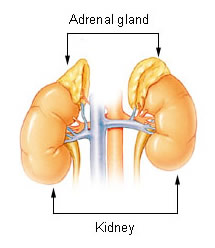
As corny as it may sound, the "creator" of cortisols is the adrenal gland. Simply put, it is the ADrenal, meaning near the renal glands. Retroperitoneally located, this "2-piece" gland is pyramidal in shape weighing 4 grams each and 2 inches in length. Surrounded by renal fascia and adipose, the suprarenal gland (its name in other literature) is.. um.. well.. an endocrine gland (what did you expect?). A little history, these glands were recognized at the late 16th century. But it was not until 1805 that a certain Cuvier geek divided the glands into 2 portions: the medulla (inner) and the cortex (outer).


Having said all these, we're not there yet. Well, technically speaking, the 2 portions of the adrenal gland produce separate set of hormones. Since cortisol is the main character in our CSI-like journey, let's focus on the cortex. It is after all the bakery baking the pie.


The adrenal cortex cells exude an array of hormones using cholesterol as its raw material. These hormones, a.k.a., corticosteroid hormones, are produced in 3 regions: zona glomerulosa (outer), zona fasciculata (middle) and zona reticularis (inner). Their cells are jam-packed with lipid droplets (housing cholesterol) used for making the hormones. Microscopic as they are, each zone produces specific hormones, somewhat like a department store. For the Glomerulosa department, mineralocorticoids such as aldosterone are "manufactured". On the other hand, Fasciculata department is responsible for supplying glucocorticoids such as cortisols. And lastly, the Reticularis department produces partly some cortisol and androgens such as androstenedione and the ever famous testosterone (though only in minute amounts).


Wait, something's still left trivial.. What are mineralocorticoids, glucocorticoids and androgens? Maybe Ma'am Ghie will discuss it to you..


...


Or not.. it is my assignment after all..


Glucocorticoids, as the name suggests, are hormones chiefly responsible for stimulating gluconeogenesis in the liver. Also, it has other roles such as stimulation of fat breakdown, amino acid mobilization from the extrahepatic tissues and glucose uptake inhibition in muscle and adipose tissues. The main glucocorticoid is cortisol (Alas!) comprising 95% of glucocorticoid activity. Otherwise known as the "stress hormone" (since it is elevated in stress), cortisol is responsible for the immobilization of free fatty acids and spare glucose for the brain. Furthermore, it regulates blood pressure, cariovascular function, and the body's protein, carbs, and fat usage. Quite handy a hormone if I might add. Hydration helps control cortisol levels. A quick tip: hydrate more in in the middle of a stressful day.


OK! Now we're done.. or not.. again.. Since i already made mention of the different "departments", might as well discuss them, right? Right! SO, mineralocorticoids were first observed in their involvement in sodium retention - a mineral. The major mineralocorticoid is aldosterone which is responsible for Na, K, and water homeostasis. It helps in increasing resorption of water and sodium and increased renal excretion of potassium. Very handy in controlling hydration.


The last is androgens. Androgens are not primarily secreted by the adrenal glands. However, they aid in the production, but only in minimal amounts. The adrenal androgens famous are dehydroepiandrosterone (DHEA) and androstenedione. So much for the so-called male hormones.


OK (again)! Now back to Mr. Bishop's case. His signs and sypmtoms would most probably be diagnosed to a Cushing's Syndrome. This condition is otherwise known as hypercortisolism due to a marked increase in cortisol levels. The next plan of action may be to check for tumors (adenoma) in the pituitary gland. Its presence cause increased production of adrenocorticotropic hormone (ACTH) which will then eventually elevate cortisol levels.


Phew! That was close (not to mention my submission is hanging by a thread)! Hope it would help much to your knowledge and understanding. Thanks! = }


For a crash course regarding the adrenal gland in general, watch this video:


-SIDETRACK-
(This part of my blog would feature some of Facts of Life. Just sharing.)
Perfection is always relative. What is perfect to me may be unsatisfactory to others. What matters is self satisfaction and inner peace. Create a craft worth remembering and live a life of content in accordance to how perfect you perceive it to be.


-References-
For Adrenal glands:
http://www.answers.com/topic/adrenal-gland
http://arbl.cvmbs.colostate.edu/hbooks/pathphys/endocrine/adrenal/steroids.html


For Glucocorticoids:
http://arbl.cvmbs.colostate.edu/hbooks/pathphys/endocrine/adrenal/gluco.html
http://en.wikipedia.org/wiki/Gucocorticoid
http://copd.about.com/od/emphysema/a/glucocorticoids.htm
http://cpharm.vetmed.vt.edu/vm8784/GLUCOCORTICOIDS/glucocort.htm


For Minelaocorticoids:
http://arbl.cvmbs.colostate.edu/hbooks/pathphys/endocrine/adrenal/mineralo.html
http://en.wikipedia.org/wiki/Mineralocorticoid


For Androgens:
http://e.hormone.tulane.edu/learning/androgens.html
http://en.wikipedia.org/wiki/Androgen

Tuesday, May 18, 2010

Endocrinology, Toxicology, Drug Test

Endocrinology

- this refers to the study of the endocrine gland (a gland directly responsible for the manufacturing and releasing of hormones; this includes the pituitary, thyroid, parathyroid and adrenal glands, the ovary and the testis, the placenta, and part of the pancreas) and the substances they secrete which includes the different kinds of hormones (functions as chemical messengers in the body) such as testosterone, androgens, insulin, glucagon, and more.


Toxicology

- a body of science which studies poisonous materials (toxins) and their deleterious effects upon living organisms including diseases.


Drug testing

- a system of both screening and identification of drug components in a given substance (such as urine) through a single or a series of tests.

Sunday, November 29, 2009

Precautions for Sodium Test # 16-10


Sodium
, being the most abundant cation in the extracellula
r fluid (90% of all extracellular cations) poses a vital role in the osmolality of plasma. Plasma osmolality is approximately 295 mmol/L, 270 mmol/L of which resulting from sodium and other associated anions. Having said this, sodium contributes greatly on water balance as it is the major active cation for this function.

When testing for Sodium in the blood, certain precautions are to be observed so as to preserve the specimen's integrity and obtain the actual values while eliminating external factors. These precautions include:

  • Water level intake should be at a normal level (3 liters for men and 2.2 liters for females - Institute of Medicine). In normal individuals, increased water intake doesn't affect Na levels significantly. However, for diagnosing hyponatremia (decreased Na levels), excessive water intake may influence tests results because of water imbalance. Dehydration may also influence the results and exhibit false positive for hypernatremia (increased Na levels).
  • Engaging in strenuous or any activity which induces sweating prior to subjecting to the test is also detrimental when it comes to testing sodium. This is due to the water loss, thus increasing the concentration of sodium which may affect the result of the test.
  • Medicine or drug intake such as anabolic steroids, corticosteroids, laxatives, cough medicines, and oral contraceptives should be declared to the physician as they increase sodium levels. Also, drugs like diuretics , carbamazepine, and tricyclic antidepressants causes decreased levels of sodium. These should be monitored and be made known to avoid false postie and/or false negative results.
  • Pre-existing conditions (diarrhea, profuse sweating, burns, vomiting, Addison’s disease, kidney disease, or congestive heart failure - low sodium levels; dehydration, diuretic use, Cushing’s syndrome, cystic fibrosis, neurological disorders, hypothyroidism, or renal failure - high sodium levels) that would define the Na abnormality should be noted to be able to rule out factors that are already evident upon the performance of the test.
  • Human errors such improper collection and preparation of specimen, specimen contamination, and empirical treatment on the test should always be avoided by the Medical Laboratory Scientist. Also, the Universal Precaution is to be observed at all times.
Ref:

Clinical Chemistry: Principles, Procedures, Correlations by Michael L. Bishop, et.al.

Henry's Clinical Diagnosis and Management by Laboratory Methods, 21st ed. by Richard A. McPherson, et.al

http://www.mayoclinic.com/health/water/NU00283

http://www.labtestsonline.org/understanding/analytes/sodium/test.html